The definition of a “Senior Developer” is changing faster than most job titles in software engineering have ever changed. For decades, seniority was mostly about experience: years of writing code, familiarity with systems, and the ability to ship features reliably.
Now, with AI pair programming tools embedded into everyday workflows, that definition is shifting. Writing code is no longer the bottleneck—it’s almost the easy part.
So what does “senior” actually mean when an AI can generate a working implementation in seconds?
The Old Definition of “Senior Developer”
Traditionally, a senior developer was someone who could:
- Write clean, maintainable code
- Design system architecture
- Debug complex issues
- Review other people’s code effectively
- Make reliable technical decisions under uncertainty
Implicitly, this also meant:
“They know more syntax, patterns, and frameworks than junior developers.”
But AI has started eroding that advantage.
What AI Pair Programming Changed
Tools like AI coding assistants have flipped the workflow:
- Boilerplate code is generated instantly
- Refactoring suggestions appear automatically
- Test cases can be drafted in seconds
- API integrations are scaffolded quickly
This means:
The value of “typing code” has dropped significantly.
Now the real bottleneck is:
- deciding what to build
- evaluating whether generated code is correct
- ensuring system-level coherence
Senior Developers Are No Longer “Best Coders”
In the AI-assisted era, being senior is not about writing the most code—it’s about writing the right constraints around code generation.
A modern senior developer is closer to:
A system designer + decision-maker + quality gatekeeper
rather than:
A fast human compiler
The New Core Skill: Problem Framing
AI is only as good as the problem you define.
Senior developers excel at:
- translating vague business needs into technical requirements
- identifying edge cases early
- breaking large problems into solvable units
- defining constraints that prevent bad outputs
Example:
Instead of thinking:
“How do I build this feature?”
A senior thinks:
“What should the system not do under any circumstances?”
That shift is subtle but critical.
Code Quality Becomes Review, Not Creation
In AI-assisted workflows, code generation is cheap. Code correctness is expensive.
So senior developers shift toward:
- reviewing AI-generated code critically
- spotting subtle logical flaws
- identifying security risks
- ensuring maintainability over time
They act like:
“AI output auditors”
Junior developers might accept generated code as “good enough.” Seniors assume:
“It is probably wrong in some edge case I haven’t seen yet.”
System Design Matters More Than Ever
AI can generate functions, components, and even services. But it struggles with:
- long-term architecture decisions
- trade-offs between scalability and complexity
- cross-service consistency
- failure mode planning
Senior developers are increasingly judged by their ability to design systems that:
- remain stable under change
- scale predictably
- degrade gracefully
- remain understandable to future developers (and AI tools)
In other words:
AI writes code. Seniors design ecosystems.
Debugging Becomes Hypothesis-Driven
Debugging used to be about stepping through code line by line.
Now, with AI-generated codebases, the challenge is different:
- you didn’t write all the code
- patterns may be inconsistent
- logic may be partially inferred by AI
So senior developers shift toward:
- forming hypotheses quickly
- narrowing down system-level causes
- identifying mismatches between intent and implementation
- tracing issues across AI-generated abstractions
They are less “code readers” and more:
“system detectives”
Communication Becomes a Technical Skill
As AI handles more implementation, humans spend more time coordinating decisions.
Senior developers increasingly:
- align with product managers
- explain trade-offs to non-technical stakeholders
- define boundaries for AI-assisted workflows
- document architectural intent clearly
Clear communication becomes a form of technical leverage.
If the system design isn’t well communicated, AI will happily implement the wrong thing at scale.
Knowing When NOT to Use AI Is a Senior Skill
One of the most underrated skills emerging today is judgment around AI usage.
Senior developers know when to:
- trust AI for scaffolding
- override AI-generated suggestions
- avoid AI entirely for critical logic
- simplify instead of over-automating
They understand:
Not every problem should be solved with a model.
This restraint is becoming a key differentiator.
The Rise of “AI Code Direction”
A new skill is emerging: directing AI effectively.
Senior developers are good at:
- writing precise prompts for coding tasks
- structuring context for AI tools
- iterating on AI outputs efficiently
- enforcing consistency across generated code
This is less about programming syntax and more about:
“Specification engineering”
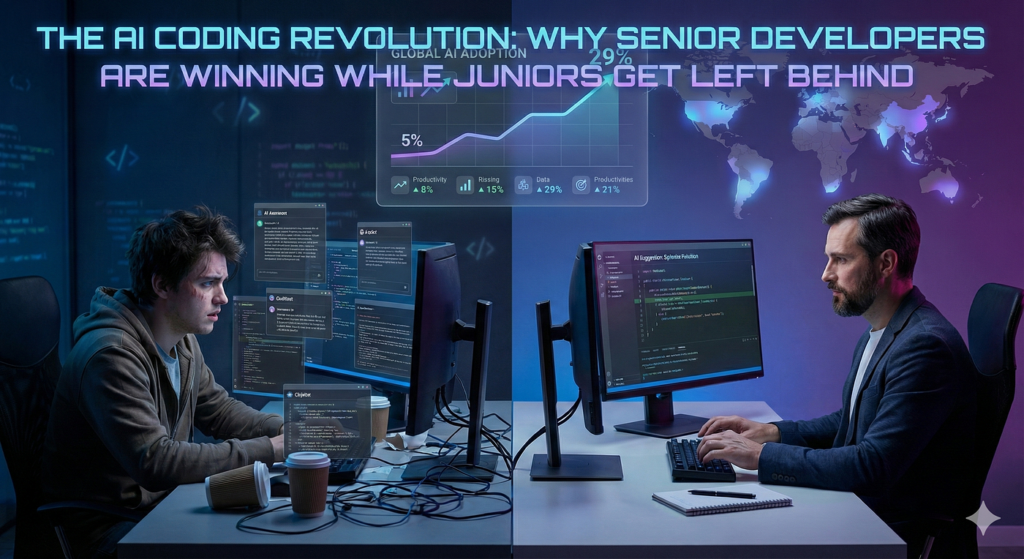
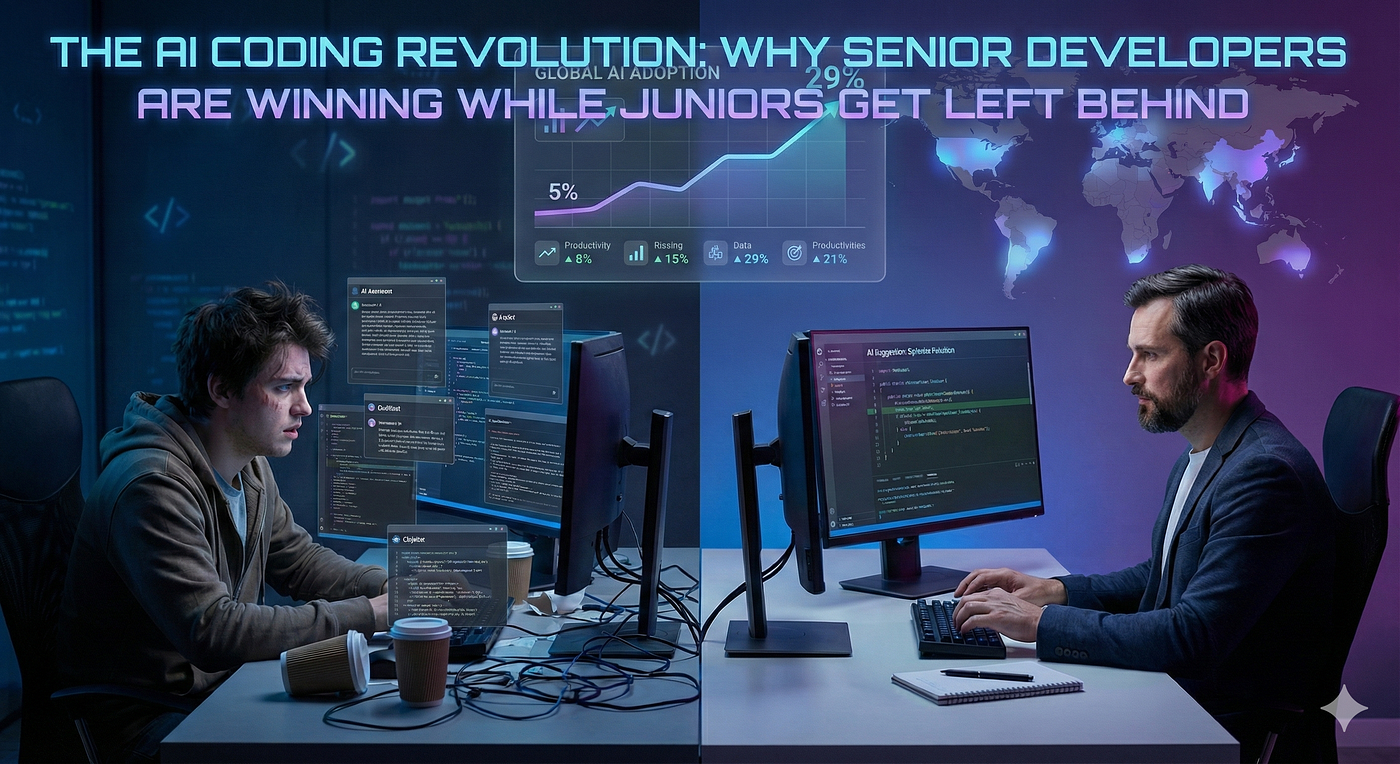
Junior vs Senior in the AI Era
A simplified comparison:
Junior Developer:
- relies heavily on AI output
- focuses on making things work
- accepts generated solutions with minimal critique
- improves through trial and error
Senior Developer:
- defines constraints for AI
- validates correctness rigorously
- anticipates system-wide implications
- designs workflows, not just features
The gap is no longer about typing speed or syntax knowledge.
It’s about:
judgment under uncertainty
The Most Important Shift: From Builder to Owner
The biggest change is psychological.
Previously:
“I build software.”
Now:
“I own systems that are partially built by machines.”
Ownership implies responsibility for:
- correctness
- scalability
- security
- long-term maintainability
AI does not remove accountability. It increases it.
What Skills Define Senior Developers Going Forward
In the AI era, seniority is increasingly defined by:
1. System Thinking
Understanding how components interact at scale.
2. Critical Evaluation
Judging AI output instead of blindly accepting it.
3. Architecture Design
Structuring systems that survive change.
4. Constraint Design
Defining rules that guide both humans and AI.
5. Communication
Aligning technical decisions across teams.
6. Judgment
Knowing what to automate and what to control manually.
A Useful Mental Model
Think of AI as:
A very fast but overconfident junior developer
Then think of a senior developer as:
The architect who assigns tasks, reviews everything, and ensures the final system actually makes sense
That framing is surprisingly accurate.
Final Thoughts
The title “Senior Developer” is not becoming less relevant—it is becoming more meaningful.
As AI lowers the barrier to writing code, the value shifts upward:
- from implementation → to design
- from syntax → to systems
- from coding → to judgment
In the age of AI pair programming, senior developers are no longer defined by how much they can build alone.
They are defined by:
how effectively they can build with machines—and still be responsible for the outcome.